
How to Catch Up in an Online Class When You’re Falling Behind

Are you worried about managing a single online course, which requires long hours of reading, writing, and active participation? The good news is that you can regain control by assessing your backlog, prioritizing crucial coursework, and creating an effective catch-up plan.
When you are balancing a full-time career, family responsibilities, military service, or clinical rotations, finding enough time can feel impossible.
In that case, you can reach out to professional online class help services.
Whether you are facing a minor gap or several weeks behind, expert help can make the workload easier to manage, help you prioritize effectively, and help you regain control of your coursework.
In this blog, we will explore steps to catch up in an online class, help you prioritize effectively, and get you back on track.
How Can I Catch Up When I’m Behind In An Online Class?
When you are falling behind in online class, the hardest part is knowing where to start without panicking. Instead of wondering how to manage the piled-up modules, use a systematic approach to break the avoidance cycle, audit your portal, and regain control of your coursework step by step.
Here we will discuss the steps how to get back on track in an online class -
Break the Avoidance Cycle:
The anticipation of what you have missed is often more stressful than dealing with the actual workload. When deadlines pile up, push yourself to confront the learning management system (LMS) and break the mental barrier causing panic. Don’t worry about the entire semester; focus on structured, actionable recovery steps. Taking smaller, controlled steps helps you manage a heavy backlog without getting overwhelmed.
Audit Your Learning Management System (LMS):
Log directly into Canvas, Blackboard, or Moodle to conduct a complete inventory of missing quizzes, pending discussion boards, and unsubmitted assignments.
Utilize External Academic Support:
When overlapping life commitments leave you short on time, or a difficult subject such as STEM, business, or nursing is slowing you down, professional online class services can help you manage the load.
What Should I Do First If I’m Several Weeks Behind in an Online Class?
If you are several weeks behind, don’t start with the oldest assignment and try to finish it quickly. First, understand your course status and how far behind you really are. In an online class, the backlog can look bigger than it is because overdue assignments, unfinished lessons, and upcoming deadlines get mixed.
Start by reviewing your course requirements, checking what you can still complete, and creating one list of outstanding work. This gives you a manageable starting point before you build an online class catch-up plan. If the backlog feels overwhelming, you can pay someone to take my online class for me.
Check Your LMS and Gradebook
Log into your learning management system (LMS) and review the course from the present week backward. Look for missing assignments, unread announcements, incomplete quizzes, discussion posts, upcoming sets, and instructor feedback.
The gradebook is useful because it shows which assignments have already received poor grades, which are missing, and how much each completed activity contributes to your result. Do not depend on the ‘missing’ label in your LMS. Some systems still show an assignment as missing even when late submission is possible.
Create a quick snapshot of:
- Missing assignments
- Upcoming deadlines
- Current grade
- Major assessments
- Locked or unavailable activities
- Instructor announcements about extensions or late work
This snapshot shows whether you are only slightly behind or dealing with a larger backlog that requires a more structured recovery plan.
Review the Syllabus and Late-Work Policy
Before spending hours completing overdue work, you should check the syllabus for the course rules on late submissions, extensions, missed exams, participation, attendance, and grade penalties.
Pay attention to whether:
- Late assignments are accepted automatically.
- A percentage is deducted for late work.
- Certain assignments cannot be submitted after the deadline.
- Instructor approval is required.
- Missed quizzes or exams have separate procedures.
- There are deadlines after which no late work can be accepted.
This step will prevent you from spending study time on coursework that can no longer receive credit. If the policy remains unclear, you can ask your instructor before making assumptions.
List Everything You’ve Missed
Keep all outstanding work in one list instead of trying to keep track of it in your head. Include both coursework that you have already missed and work that is coming up soon.
A simple list can include:
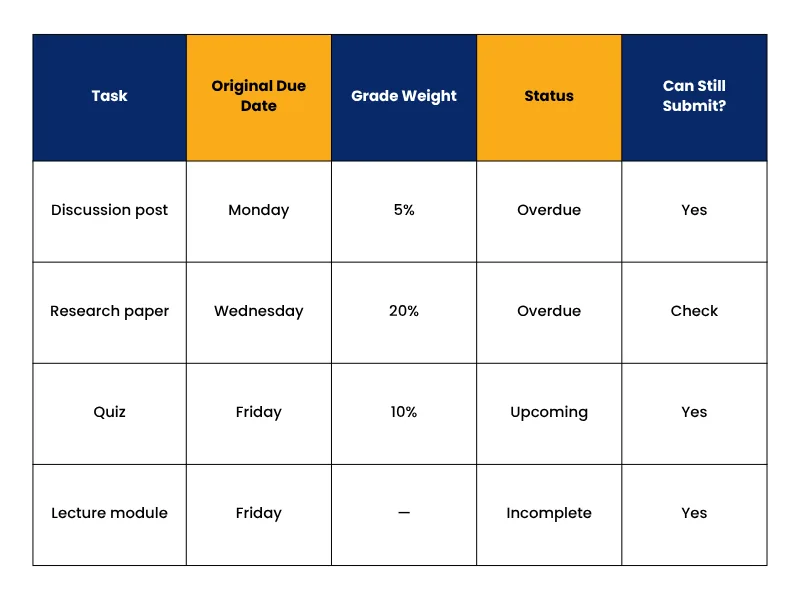
A simple list turns an overwhelming backlog into specific tasks you can evaluate and schedule.
Identify What Is Still Recoverable
You need to sort your backlog according to what is still recoverable, requires the instructor’s approval, or is unrecoverable. You should prioritize coursework that is recoverable and worth doing since you have limited time and energy.
For instance, a major paper that contributes 20% of your grade is more important than a discussion post that contributes 5% of your grade, especially if the two assignments are both overdue.
It is not about getting everything done, but rather about prioritizing the items that you can recover and those that would have the most significant impact.
Should I Contact My Professor If I’m Behind?

Yes, if falling behind has impacted a major assignment, grade, or other course requirement.
Keep the message brief and to the point, and refrain from demanding language or long explanations.
Describe the situation where you have fallen behind and ask if there are any approved alternatives open to you, and avoid making any assumptions.
If there is already a detailed policy on late work in your syllabus, adhere to it and ask your professor about anything else not covered by it, such as an alternative to a high-value assignment.
How Do I Make a Catch-Up Plan for an Online Class?
Once you have identified what you are lacking, this will give you a realistic timeline. When figuring out how to catch up in an online class, you should prioritize the catch-up work while still allowing you to complete the current coursework.
Planning on ‘catching up as fast as possible’ when you do not take into account your other commitments will lead to more missed deadlines. Instead, plan out how to create a deficit reduction in coursework while continuing your current studies.
Calculate Your Available Study Time
Start with the number of hours you can dedicate to the course each day or week.
Consider your:
- Work schedule
- Family responsibilities
- Commute
- Sleep
- Other courses
- Existing commitments
- Fixed deadlines
Do not schedule every minute you have for coursework. A plan that requires you to study eight hours every evening may look productive but may be impossible to maintain.
For example, if you realistically have 12 hours available during the week, decide how those hours will be divided between current coursework and catch-up work.
Your schedule should reflect the time you actually have, not the time you wish you had.
Separate Current Work From Backlog
One of the biggest mistakes students make when trying to catch up on online classes is focusing exclusively on overdue work and letting current coursework slip. If the combined workload exceeds what your schedule allows, vetted academic experts can help you manage it and keep your online class on track.
If you spend the entire week completing old assignments, new assignments can become overdue too.
Instead, divide your workload into two categories:
- Current coursework: Work due soon that needs to stay on schedule.
- Backlog: Older work that you are trying to recover.
For example, you might reserve specific study blocks for upcoming coursework and separate blocks for overdue assignments. This approach helps you reduce the backlog without letting it keep growing.
Break Large Assignments into Smaller Tasks
Large assignments can become a major source of procrastination when you are already behind. Instead of putting “finish research paper” on your schedule, divide it into manageable steps.
For example:
- Read the assignment instructions
- Review the grading rubric
- Choose or confirm a topic
- Find appropriate sources
- Create an outline
- Draft the assignment
- Revise and proofread
- Submit the final version
Assign each step to a specific study session where possible.
This makes your online class catch-up plan easier to follow because you can measure progress by completed actions rather than waiting until an entire assignment is finished.
Set Daily Catch-Up Targets
Use specific targets instead of vague goals such as “study more” or “catch up today.”
A useful target might be:
- Complete one overdue discussion
- Review two missed lecture modules
- Finish the first half of a paper
- Submit one recoverable assignment
- Prepare for an upcoming quiz
Keep the targets realistic. Consistently completing three important tasks is more useful than creating a list of ten tasks you cannot finish.
At the end of each day, check what was completed and move unfinished tasks to another realistic time slot.
Leave Buffer Time for New Deadlines
Your catch-up schedule should have some flexibility. Unexpected work, technical problems, difficult assignments, and new course requirements can disrupt even a carefully planned week.
Leave some unscheduled time for:
- New assignments
- Instructor responses
- Revisions
- Technical issues
- Unexpected personal commitments
A buffer also prevents one missed study session from causing the entire recovery plan to collapse.
How Should I Prioritize Missed Assignments When I’m Behind?
When you are behind in an online class, completing assignments in the order they were originally assigned is not always the best strategy. Instead, consider their grade value, deadlines, recoverability, and relationship to upcoming coursework.
A simple priority system can help you decide what deserves your attention first.
Prioritize by Grade Weight
Look at how much each assignment contributes to your final grade.
A major project worth 20% may have a much greater impact than several small activities worth 1-2% each. That doesn’t mean you should automatically ignore smaller assignments, but grade weight can help you decide where limited study time matters most.
Start by identifying:
- Major papers or projects
- Midterms and final assessments
- High-value quizzes
- Smaller assignments
- Participation activities
Then compare their value with their deadlines and whether you can still submit them.
Consider Deadlines and Late Policies
An assignment’s deadline matters even when you are already behind.
For overdue work, decide whether you can still submit it and whether a late penalty applies. For upcoming work, consider how soon it is due and whether missing it would create another problem.
For example, an overdue assignment worth 15% may be important, but an exam tomorrow worth 25% may require immediate preparation.
The priority should therefore reflect both what you have missed and what you are about to miss.
Identify Work Needed for Upcoming Assessments
Some missed coursework provides knowledge you need for an upcoming assignment or exam.
For example, if a later project requires concepts introduced in an earlier module, reviewing that material may be more valuable than completing an unrelated low-value task.
Ask: “Do I need this material to complete something due soon?”
If the answer is yes, move that material higher on your list.
This helps you catch up in an online class strategically instead of treating every missed task as equally urgent.
Use a Simple Priority Matrix
A basic priority matrix can make decisions easier:
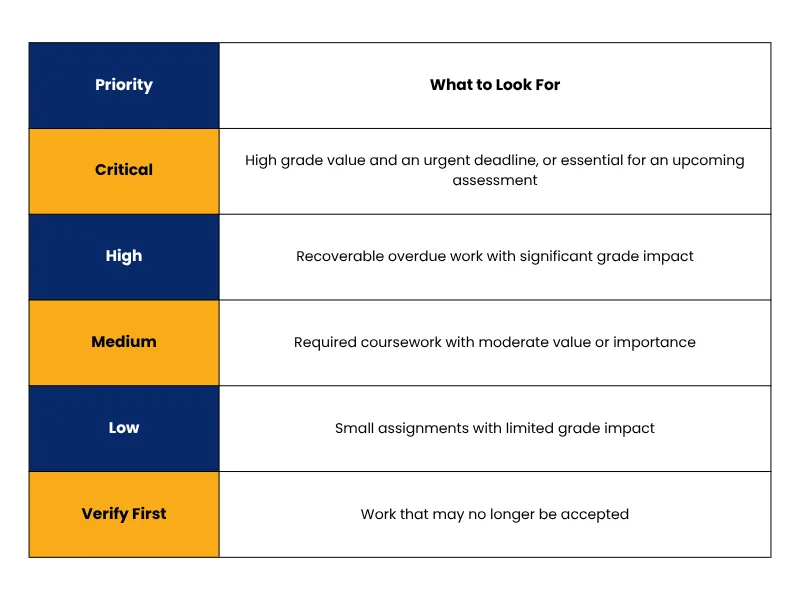
The “Verify First” category is important. If an assignment is locked or appears far past the late-work window, confirm whether it can still earn credit before spending significant time on it.
How Can I Catch Up On Online Lectures, Readings, And Discussions Quickly?
When you are falling behind in online course modules, catching up is not only about completing assignments. You may also have several lectures to watch, readings to finish, and discussion activities to review.
You do not necessarily need to consume every piece of material in the same way you would have during the original week. Prioritize the material that supports your upcoming coursework and assessments.
Catch Up on Online Lectures
Start with the lecture objectives, slides, notes, transcripts, or other available summaries before watching every recording from beginning to end.
If a lecture is recorded, check whether the platform allows playback controls. You can slow down difficult explanations and move more quickly through familiar material.
Pay particular attention to:
- Concepts used in upcoming assignments
- Topics emphasized by the instructor
- Material covered in quizzes or exams
- Areas you do not understand
If a missed lecture covers material you don’t need immediately, you may be able to review it after addressing higher-priority coursework.
Catch Up on Required Readings
Do not approach a large reading backlog by simply counting pages.
First identify which readings are:
- Connected to an upcoming assignment
- Covered on an upcoming assessment
- Specifically emphasized by the instructor
For longer chapters, use the course objectives and headings to understand what you need to learn. Take concise notes on key concepts instead of rewriting entire sections.
The goal is to regain enough understanding to participate in the course and complete required work effectively.
Catch Up on Discussion Posts
Discussion boards can be especially difficult when you fall behind because some activities close after a set period.
Before spending time writing a response, check:
- Whether the discussion is still open
- Whether late posts are accepted
- Whether both initial posts and replies are required
- How much the activity contributes to your grade
If a discussion is still available and carries meaningful grade value, include it in your catch-up schedule. If it is closed, check the course policy before assuming you can submit it another way.
How Can I Balance Overdue Coursework with Upcoming Deadlines?

The biggest challenge in managing missed assignments in online class workloads is that the course doesn’t stop while you clear the backlog. New assignments may continue to appear while you are still completing older ones.
The solution is to recover and prevent issues at the same time.
Keep Current Coursework from Becoming Overdue
Check upcoming deadlines before starting your catch up in an online class session.
If an assignment is due tomorrow, you may need to address it before spending several hours on an older task. Staying current keeps the backlog from growing.
A simple daily check can include:
- What is due today?
- What is due within the next three days?
- What overdue work can still earn credit?
- What major assessment is approaching?
This takes only a few minutes but keeps your priorities from becoming outdated.
Set Dedicated Backlog Time
Give overdue work its own place in your schedule.
For example, you might use part of your available study time for current assignments and reserve another block for recoverable backlog work.
The goal isn’t to follow a fixed percentage every week. Your split should change based on your situation.
If a major exam is approaching, current preparation may need more time. If several overdue assignments are still recoverable, you may temporarily increase your backlog time.
Adjust the Plan Each Week
A catch-up plan should change as your course changes.
At the end of each week, review:
- What you completed
- What remains overdue
- New assignments
- Upcoming assessments
- Changes to your available study time
- Instructor responses about late work
Then revise the following week’s schedule.
This keeps your plan realistic instead of forcing you to follow a schedule you made before you knew the actual workload.
How Long Does It Usually Take to Catch Up in an Online Class?
There is no standard number of days required to catch up in an online class. Recovery time depends on how far behind you are, how much coursework you missed, how many hours you can study, and which assignments you can still complete.
As a general guide:
- A few days behind: You may be able to recover through several focused study sessions.
- About a week behind: You may need a structured catch-up schedule while continuing current coursework.
- Several weeks behind: Recovery may take multiple weeks and may require communication with your instructor.
- Near the end of the course: You may need to prioritize recoverable, high-impact coursework rather than trying to complete every missed activity.
The amount of work matters more than the number of days. One week of missed discussion posts is very different from one week containing a research paper, exam, lab, and several quizzes.
A better question is:
How many hours of recoverable work do I have, and how many realistic study hours can I dedicate each week?
For example, if you estimate 15 hours of recoverable coursework and can consistently dedicate five additional hours per week to your backlog, that’s roughly three weeks to clear it. Use that as a starting point for estimating your recovery timeline.
Use that estimate as a planning tool, not a guarantee. Your workload can change as new assignments, instructor feedback, or other responsibilities arise.
When Should I Consider Dropping or Withdrawing from an Online Class?
If you are significantly behind and cannot realistically complete the remaining coursework, withdrawing may be worth considering. However, being behind for a few weeks does not automatically mean you should drop the class.
Consider your options when:
- You cannot meet the remaining course requirements: If the remaining workload is no longer manageable within the time available, continuing may put your other courses or responsibilities at risk.
- Your expected grade is unlikely to meet your requirements: Review your current grade, remaining assessments, and grading policy to determine whether passing is still realistic.
- The course is affecting your other academic commitments: Spending most of your available time trying to recover one course can create problems in other classes.
- Your circumstances have changed: Work, family responsibilities, financial difficulties, or other major changes may make continuing the course impractical.
Before withdrawing, check your institution’s withdrawal deadline, tuition-refund policy, financial-aid requirements, and potential transcript consequences. If you are unsure, speak with your academic advisor or student services office before making a decision.
Base your decision on your overall academic situation, not just the stress of a large backlog. If completing the course remains realistic, a structured recovery plan may be a better option.
Mastering How to Catch Up in an Online Class: Turn Your Semester Around Today
Falling behind in an online class can feel overwhelming, but you can regain control by reviewing your backlog, prioritizing recoverable work, and balancing missed tasks with upcoming deadlines. Focus on steady progress rather than trying to finish everything at once.
If work, family responsibilities, or difficult coursework are making it hard to catch up, academic support can help you manage challenging material and stay organized.
Need help with a demanding online class? Explore TakeMyOnlineClassPro’s academic support options for guidance with your coursework and online learning needs.
Frequently Asked Questions
How can I catch up on an online class without staying up all night?
Instead of cramming your backlog into a couple of long study sessions, set a reasonable number of hours per day to dedicate to catching up and pace yourself. Prioritize coursework with the highest grade value, the nearest deadline, or the most relevance to upcoming assessments, and set aside enough time to get proper rest and complete your other assignments promptly.
How can I stay motivated when I have a large online coursework backlog?
Make your backlog seem less overwhelming by focusing on one thing at a time. Focus on one small section or one particular assignment that you can complete in one sitting, and make sure to track your progress so that you can see what you have accomplished. Try to prioritize small, attainable goals instead of focusing only on completing everything you are behind on. If it is too overwhelming, ask your instructor or teaching assistant (TA) for help.
What should I do if my online class does not allow late submissions?
First, find out which assignments can still be submitted late and which cannot. Don’t spend hours on work that will no longer be graded. If you have a valid reason for an exception, ask your instructor whether one is possible. Otherwise, put your time into assignments that still count toward your grade.
What if I cannot catch up before the next major exam or project?
Do not try to complete everything that you are behind on before preparing for your assessment. Prioritize reviewing for the assessment and studying everything that will be on it, along with any coursework you need for it. Set aside time to complete or review any other assignments that you are significantly behind on after you adequately prepare for it before the assessment. If it is unreasonable to expect you to complete everything that you are behind on before your test, ask your instructor whether an extension or alternative arrangement is possible.
What should I do if I do not understand the material I missed while catching up?
If the material that you missed is essential for something else that you need to complete, take a break from trying to complete more coursework and thoroughly review whatever notes, PowerPoints, textbook sections, or other materials pertain to the thing that you do not understand. Ask for tutoring or additional help if you still need assistance. You don’t need to spend much time relearning material that is no longer relevant, but make sure you fully understand anything you will need to apply later in the course.